


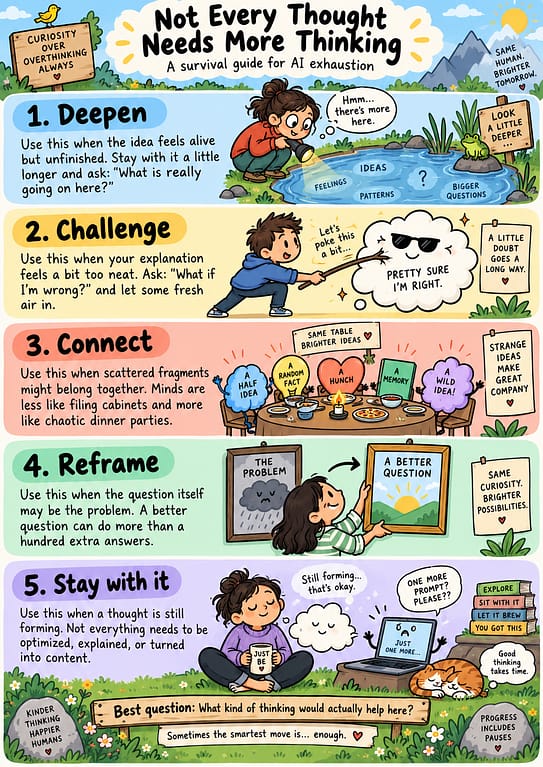
Not Every Thought Needs More Thinking
We are living in a strange age.
For almost any question, we can now ask for more.
More analysis.
More angles.
More context.
More options.
More prompts.
More bullet points.
And sometimes, after all that, we understand absolutely nothing better.
We are just tired.
Maybe the useful question is not always: “How can I think more about this?”
Maybe it is: “What kind of thinking would actually help here?”
There are a few possibilities.
Deepen
Sometimes a thought is interesting but still a little thin.
You have the feeling there is something there.
So you stay with it a little longer.
Not twenty-seven tabs longer.
Just long enough to ask: “What is really going on here?”
Challenge
Sometimes we become very fond of our own explanation.
This is usually the perfect moment to become mildly suspicious of it.
Ask:
“What if I am wrong?”
Not in a dramatic, existential way.
Just enough to let some fresh air into the room.
Connect
Sometimes the useful idea comes from somewhere else entirely.
A conversation.
A memory.
Something you saw years ago.
A completely unrelated problem.
Our minds are surprisingly good at this.
They are less like filing cabinets and more like slightly chaotic dinner parties.
Reframe
Sometimes the problem is not the problem.
The frame is.
We may be asking: “How do I become more productive?”
when the better question is: “Why am I trying to fit twelve hours of life into six?”
A new question can sometimes do more than another hundred answers.
Or… do nothing
This one may be the hardest.
Sometimes a thought does not need to be deepened, challenged, connected, optimized, summarized or turned into a framework.
Sometimes it can just sit there.
Not everything needs immediate processing.
Not every uncertainty needs closure.
And not every thought needs to become content.
Especially now.
With AI available everywhere, the temptation is to keep going simply because we can.
One more prompt.
One more perspective.
One more “comprehensive breakdown.”
But intelligence is not always about adding more.
Sometimes it is knowing what kind of movement would help.
And sometimes it is knowing when to stop moving altogether.
Your brain may even send you a helpful signal.
It is called:
“Enough.”
Worth listening to.
Online course publication on Amazon


