
In Defense of the Em Dash
In Defense of the Em Dash — A Small Rebellion in Punctuation
Apparently, the em dash has become suspicious.
Poor thing.
For generations, it lived a respectable little life in novels, essays, newspapers, letters, manuscripts, and the hands of editors who knew exactly what to do when a comma felt too weak, a parenthesis too apologetic, and a full stop far too final.
Then artificial intelligence arrived.
And suddenly the em dash needed an alibi.
There is something wonderfully absurd about this.
The em dash did not wake up one morning and decide to become evidence of machine authorship. It did not sign a secret agreement with ChatGPT. It did not infiltrate our keyboards under cover of darkness.
It was already here.
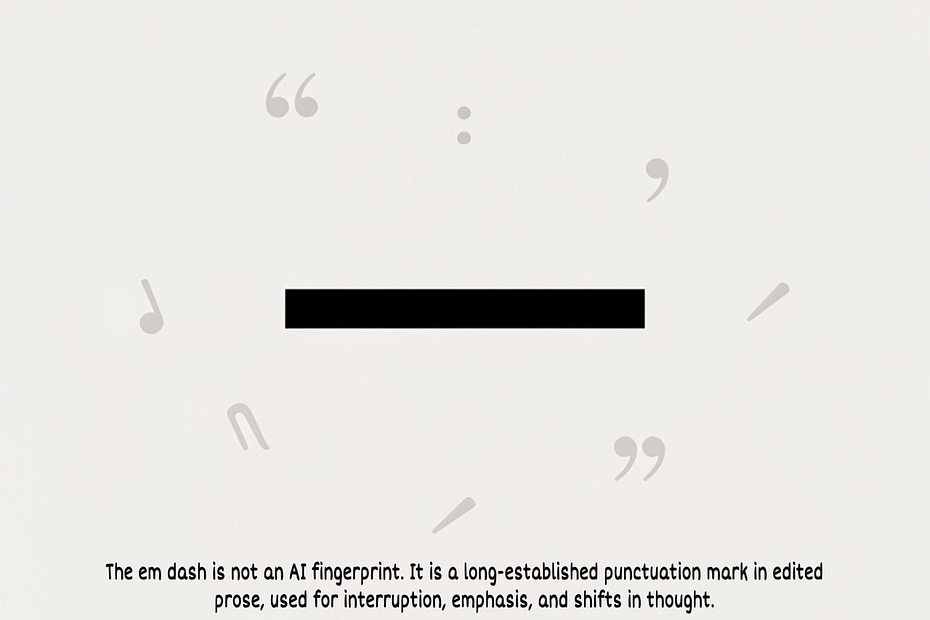
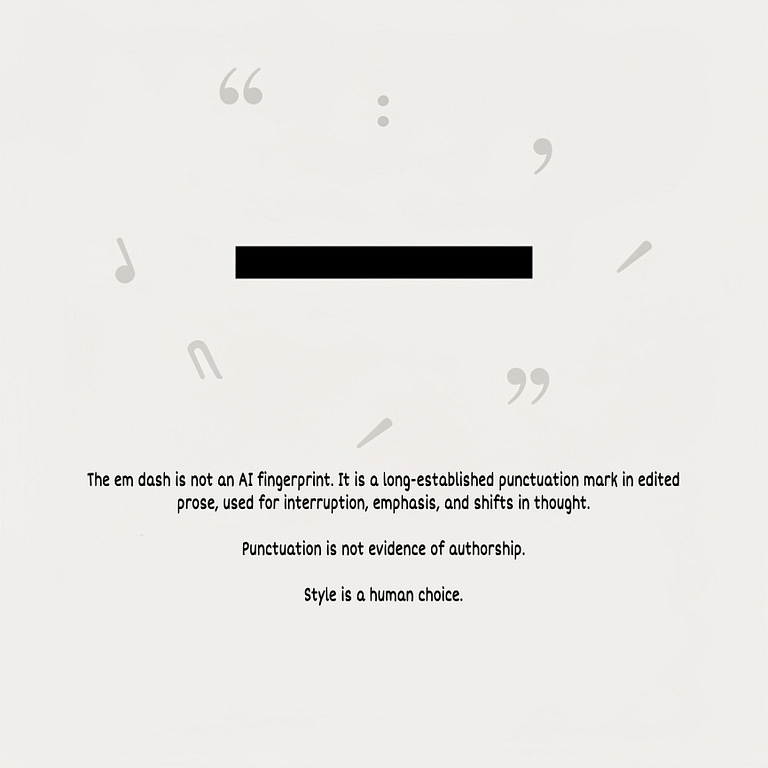
Writers have long used the em dash to create interruption, emphasis, suspense, afterthought, rhythm, contrast, and that peculiar little turn in a sentence where the mind seems to change direction while you are watching it happen.
Which is precisely why I like it.
A semicolon is composed.
A colon stands at attention.
Parentheses whisper from the sidelines.
But an em dash?
An em dash opens the door halfway through the sentence and says, “Actually — there is something else.”
That is not bad writing.
That is thought having a pulse.
The strange hunt for “AI tells”
We seem to have entered an era in which people search writing for clues.
Too polished? AI.
Too structured? AI.
Certain words? AI.
Three tidy bullet points? AI.
Em dash?
Caught you.
Except humans have been doing all of those things for a very long time.
The danger is not merely that we might incorrectly identify machine-written text. The stranger danger is that human writers may begin deliberately flattening their own style because some perfectly ordinary feature of language has temporarily become associated with AI.
Imagine telling a novelist to stop using semicolons because a language model discovered them.
Or telling a poet that metaphors now look suspicious.
Or informing an editor that paragraphs of roughly similar length are no longer permitted.
At some point, the detective work becomes more peculiar than the supposed crime.
Punctuation is not a fingerprint
There are certainly ways in which AI-generated writing can feel generic.
It may repeat structures. It may over-explain. It may arrive wearing an unnecessarily tidy little suit. It can occasionally sound as though every paragraph has been called into a meeting and reminded of the brand guidelines.
Those are worthwhile things to notice.
But punctuation by itself tells us very little about who — or what — wrote something.
An em dash is simply a tool.
And like every writing tool, it can be used beautifully, badly, excessively, sparingly, deliberately, accidentally, elegantly, or with the enthusiasm of someone who has just discovered the button on the keyboard.
The interesting question is not: “Did they use an em dash?”
It is:
“Does this sentence sound alive?”
I intend to keep mine
So I am making a small declaration.
I will continue using em dashes.
Not because artificial intelligence uses them.
Not despite artificial intelligence using them.
Simply because sometimes a sentence needs a small opening in the middle — a breath, a pivot, a surprise.
Sometimes two thoughts belong together more closely than a full stop allows.
Sometimes parentheses feel too timid.
Sometimes a comma simply cannot carry the furniture.
And sometimes — forgive me — an em dash is exactly the right mark.
Language has survived printing presses, typewriters, spellcheckers, predictive text, autocorrect, word processors, and generations of people insisting that somebody else is using it incorrectly.
I suspect the em dash will survive ChatGPT too.
So let it remain where it has always belonged:
not in the evidence locker,
but in the writer’s toolbox.
Preferably somewhere near the good pencils.
Source OpenAI’s ChatGPT Language Model – Images Picsart
The golden feather’s waiting. Write with purpose. Profit with poetry.
Witty Wordsmith Mode – Poetic Precision for Content that Sings
Thank you for reading and sharing!
Related Posts

Question about Errors in Image Formats and Size

Day 3 – Why Most People Quit WA (And How You Won’t)

Affiliate Programs That Pay

6 Best Affiliate Programs For Beginners

What Is Affiliate Marketing
How To Choose A Niche For Affiliate Marketing

How To Start Affiliate Marketing As A Creator

How To Use Keywords Effectively Is The Backbone

Build A Team For Your Affiliate Business