
Why am I not making money with affiliate marketing?
Affiliate Income Slow or Zero? Find Out Which Stage Your Site Is Stuck At
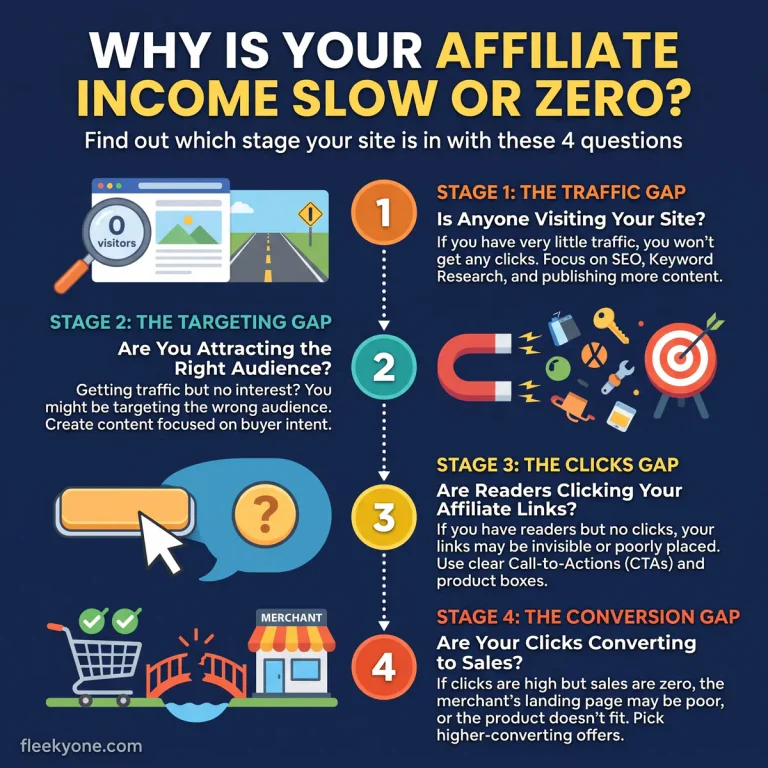
Why am I not making money with affiliate marketing? Almost always because the site is stuck at one of four points on the path from visitor to commission: nobody arrives, nobody clicks, nobody buys, or the sales are too small to notice. Find which one is yours and you only have one problem to fix, instead of a vague feeling that nothing works.
Why is my affiliate income so slow? The short, unglamorous answer
Affiliate income is the last link in a chain. A stranger has to find your page, trust it enough to read it, click a link, land on a sales page, and decide to buy. If any link in that chain is broken, the money at the end is zero, and it looks the same from the outside whichever link it is.
That is why generic advice fails. “Write more content” helps a site with no visitors and does nothing for a site with plenty of visitors and no clicks. “Improve your calls to action” helps the second site and is wasted on the first. Treating all four problems with the same medicine is how people spend months busy and unpaid.
The unglamorous part is time. Search engines need to find, read and rank new pages, and readers need to trust a site they have never heard of. Some of what looks like failure is a site that is simply early. The check further down helps you tell the two apart.
The complaints that keep coming up, sorted into four stuck points
The same few complaints show up in affiliate forums and comment sections again and again. Here they are in paraphrase, matched to the stage where each one usually comes from:
What you might be saying Your stuck point “I’ve published a pile of posts and my traffic chart is flat.” 1. Nobody is showing up “People visit but my affiliate links never get touched.” 2. They show up, but nobody clicks “I can see clicks in my dashboard and still no sales.” 3. They click, but nobody buys “I get a sale now and then, but it barely covers a coffee.” 4. Sales, but tiny income
For the two-minute version, open your analytics and your affiliate dashboard side by side and ask four questions in order:
- Are real people visiting your pages? If not, you are at stuck point 1.
- Of the people who visit, are any clicking your affiliate links? If not, stuck point 2.
- Are clicks turning into purchases? If not, stuck point 3.
- Are purchases happening but paying very little? Stuck point 4.
Stop at the first question you answer “no” to. That is your stage. Later stages are not worth working on until the earlier ones are healthy, because there is nothing for them to improve.
Stuck point 1
Nobody is showing up (and what to do before anything else)
Before you write another post, check that search engines can see the pages you already have. Type site: followed by your domain into Google and look at what comes back. If your posts are missing, the problem is indexing, and it comes before any content question. Connecting the site to Google Search Console shows which pages are indexed and which are not, and gives a reason for the ones that are not.
If your pages are indexed and still nobody visits, the usual cause is that the posts answer questions nobody types. Titles like “Everything about skincare” or “My thoughts on hosting” are broad and crowded, and a new site has little chance of ranking for them. A post that answers one narrow, specific question has a better chance of being found by someone with that exact question.
The one fix: write posts around specific questions a buyer would type, one question per post, with the question or a close version of it in the title and the answer near the top. Look at the suggestions that appear as you type into a search box, and at the “People also ask” boxes in results, to find the wording real people use.
Visitors usually come one narrow post at a time. If your site feels like a ghost town, this is the stage to work on, and my piece “When your website feels like a ghost town” covers it in more depth.
Stuck point 2
They show up, but nobody clicks
Here the traffic exists, but the affiliate links sit unused. Open one of your better-visited posts and read it as a stranger would. Is there a link in the first screen? Does the post ever say plainly which product you recommend and why? Many posts talk around a product for 1,200 words and then tuck a link into the final paragraph, where most readers never get to.
Another common cause is a post that attracts the wrong readers. A page titled “What is hosting?” brings people who want a definition, not a purchase. They read, learn the answer and leave, which means the page did its job and your link had no part in it.
The one fix: on your most-visited post, state your recommendation early, in plain words, with a link on text that says what the reader gets. “Here is the host I would pick for a first blog, and why” gives a reader a reason to click. “Click here” gives none. Then check the page on a phone, since many visitors arrive there, and make sure the link is easy to see and tap.
One more thing to confirm: disclose that your links are affiliate links. It is expected by readers and required in many places, and a clear, honest note tends to help trust rather than hurt it.
Stuck point 3
They click, but nobody buys
Clicks without purchases mean the reader was interested enough to look and not convinced enough to buy. The cause is usually one of three mismatches:
- Promise mismatch. Your post says one thing and the sales page says another, or the product does not quite solve the problem your post described.
- Audience mismatch. You recommended something that suits experts to readers who are beginners, or the reverse.
- Trust gap. The reader has no idea why you recommend this product, who it suits, or what it costs, so the sales page is the first time they see a price and they back out.
The one fix: write the honest pre-sale inside the post. Say who the product is for, who it is not for, what it costs, and what a buyer should expect in the first week. A recommendation that admits a limit is more believable than one that sounds like a brochure. Then click your own link as a visitor and read the page it lands on, to confirm it matches what you promised.
It is also worth checking that you are sending readers to the right page of the program. Some programs have several landing pages, and a beginner dropped onto an advanced page tends to leave. For more on this stage, my piece Your Affiliate Links Get Clicks and Nobody Buys? goes through it in detail.
Stuck point 4
A few sales, but the income feels tiny
Getting a first sale means the whole chain works, and that deserves a moment of credit. Tiny income at this stage is a question of scale and of what you are selling, not of whether the site works.
Three things set the size of your income, and each can be checked in your affiliate dashboard:
- How many readers reach the sale. Sales come from specific posts, and often a small number of them.
- What each sale pays. Programs differ in commission rate, in whether the payment is one-time or recurring, and in how long after a click a purchase still counts. Read the terms of each program you promote.
- Whether there is a next step. A reader who buys one thing may be ready for a related one, and if your site never mentions it, that income goes unclaimed.
The one fix: find the single post that produced your sales and build around it. Write two or three more posts on closely related questions, written for readers who are a step further along, and link them to each other. Doing more of what has already worked beats starting a new topic from scratch.
If you promote only low-paying, one-time offers, look at whether a better-fitting program exists for the same readers. Compare the terms honestly, and only recommend products you would be comfortable recommending anyway.
The “is it me or is it time?” check before you change everything
Changing everything at once is tempting when income is zero, and it makes things worse, because you can no longer tell which change did what. Run these checks first.
Signs it is mostly time:
- Your pages are indexed, and Search Console shows impressions slowly rising even though clicks are few.
- Your posts are recent, and most of them have not been live long enough for search engines to rank them properly.
- Each month looks a little better than the last in at least one stage.
Signs it is something to fix:
- Pages are not indexed at all.
- Posts have been live for a long stretch with zero impressions.
- Visitors arrive and your recommendation is hard to find or never stated.
- Clicks arrive and the landing page does not match your promise.
If you land in the first list, keep publishing steadily and leave the structure alone. If you land in the second, fix the item that matches your stuck point and nothing else until you have given it time to show a result. One change per stage, then wait and measure.
A 30-day plan for the stage you picked, one fix at a time
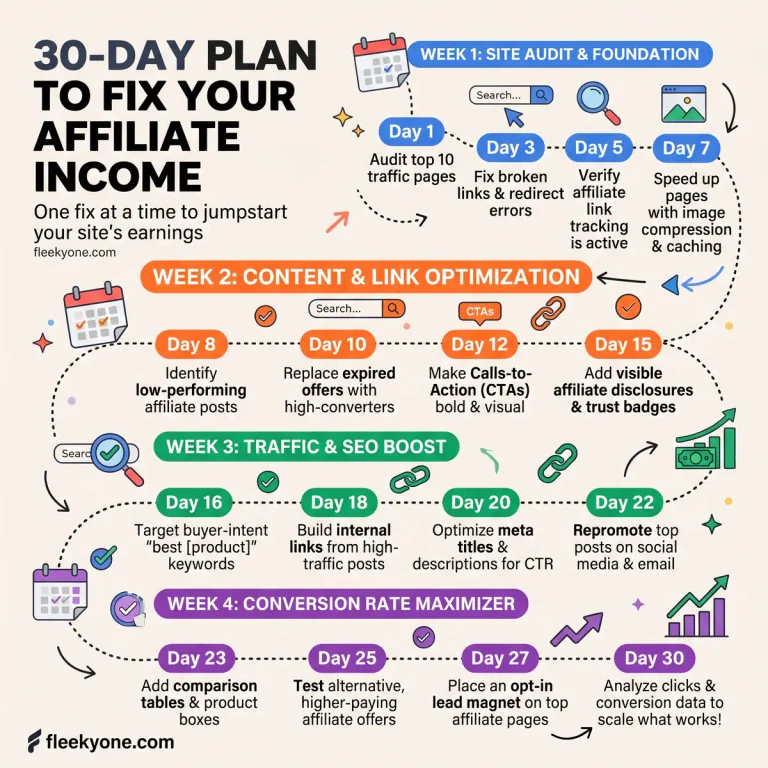
Whatever your stage, the month has the same shape. Week 1 is for measuring, weeks 2 and 3 are for the fix, and week 4 is for checking whether it moved anything.
Week 1, for everyone: write down your current numbers: visitors, affiliate clicks, sales, and earnings. Pick your stuck point using the four questions above. Do not change anything yet, since this is your baseline.
Weeks 2 and 3, by stage:
- Stage 1 (no visitors): confirm indexing, fix anything blocking it, then publish a post on one narrow question each week, built around wording real people use.
- Stage 2 (no clicks): rewrite the top of your three most-visited posts so the recommendation and its link appear early, with link text that describes the benefit. Check each on a phone.
- Stage 3 (no purchases): add an honest “who this is for and who it is not for” section, with price and expectations, to each post that gets clicks. Click through your own links and fix any mismatch with the landing page.
- Stage 4 (tiny income): identify the post behind your sales, write two related posts for readers a step further along, link them together, and review the terms of your programs.
Week 4, for everyone: record the same numbers you wrote down in week 1 and compare them. If the stage you worked on improved, even a little, repeat the cycle on that stage or move to the next one. If nothing moved, give it another month before deciding the fix was wrong, since pages and readers both take time.
A full path from a blank website to a first commission is laid out in Your Affiliate Marketing Roadmap, From Zero Website To First Commission, which is useful if you want to see where your stage fits in the larger sequence.
Slow income is rarely a verdict on you. It is a measurement, and now you know which part of the path it is measuring ☕
Pick your stuck point, fix just that one thing this month, and if you want company and feedback while you do it, have a look at Wealthy Affiliate through my referral link.
Ready to turn your passion into profit?
Join Wealthy Affiliate and learn step-by-step how to promote WA (and apply the same strategies to any niche).
👉 Build skills.
👉 Grow traffic.
👉 Create success on your terms.