AI Brain Fog Self-Assessment Quiz
AI brain fog isn’t a formal scientific term, but it’s increasingly used in casual discussions to describe a mental fatigue or cognitive overload people experience after prolonged or intense interaction with AI systems. Especially in creative, decision-making, or knowledge-based tasks. Here’s a breakdown of what it usually refers to:
🔍 What Is “AI Brain Fog”?
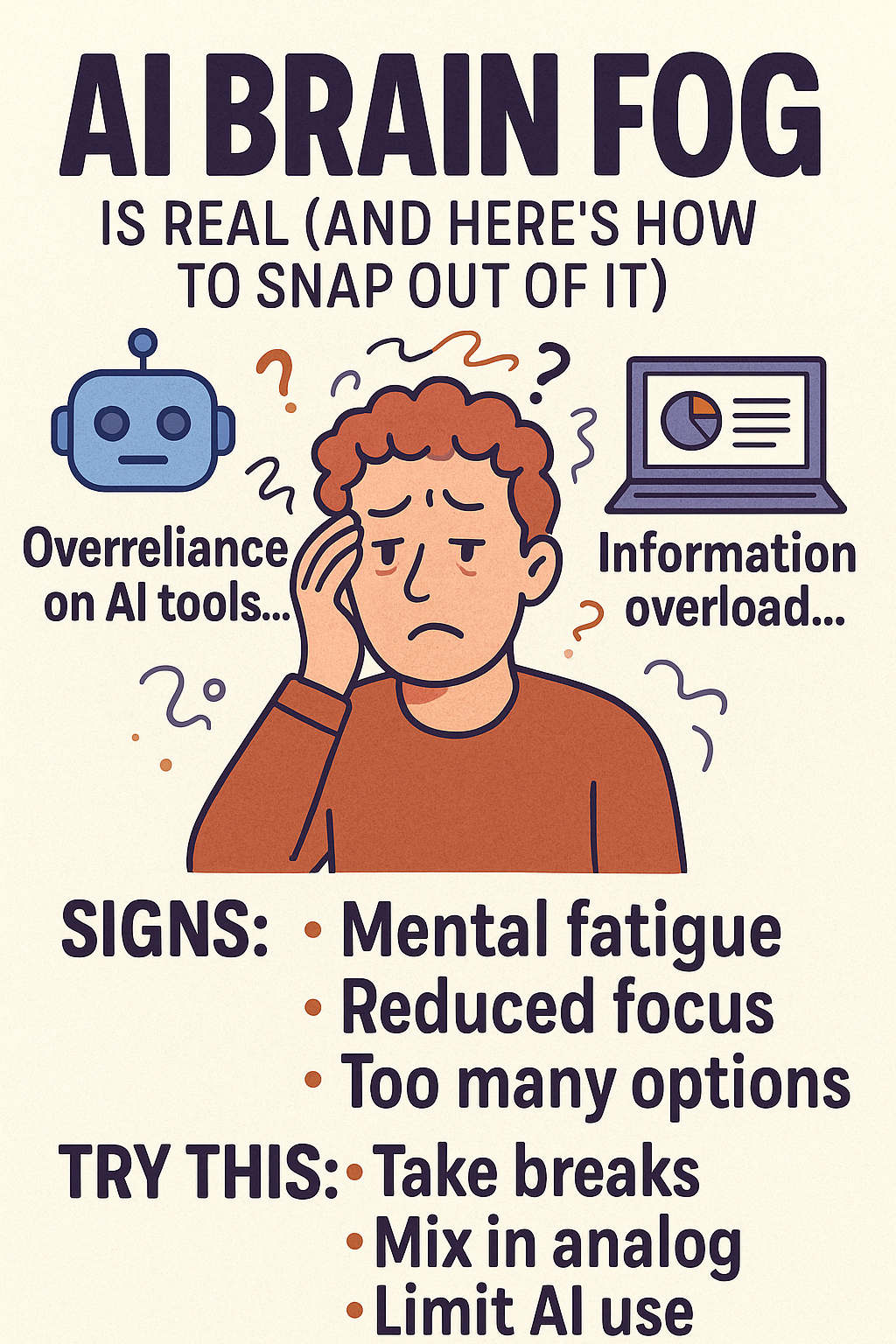
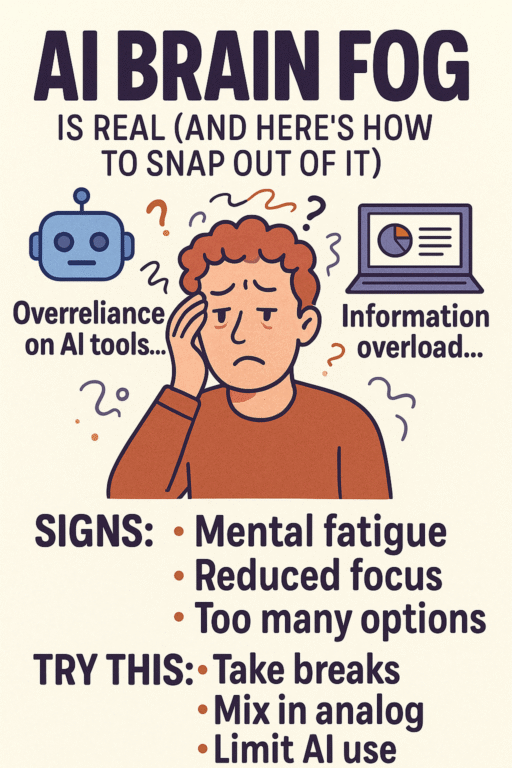
AI brain fog describes a state of mental exhaustion, reduced focus, or confusion that can result from:
- Over-reliance on AI tools for thinking, writing, or problem-solving.
- Information overload from rapid exposure to large amounts of data or suggestions generated by AI.
- Decision fatigue from evaluating and choosing among AI-generated options.
- Detachment from original thinking, leading to a dulling of one’s critical or creative faculties.
🧠 Why Does It Happen?
Several cognitive and psychological factors contribute:
- Cognitive offloading: Letting AI do the thinking can reduce mental engagement.
- Constant switching: Jumping between prompts, edits, and AI suggestions can lead to cognitive strain.
- Paralysis by analysis: Too many AI-generated possibilities can overwhelm decision-making.
- Loss of flow state: AI interruptions can break deep focus during creative work.
⚠️ Signs of AI Brain Fog
- Feeling mentally drained after interacting with AI tools.
- Difficulty focusing or making decisions.
- Struggling to recall what was AI-generated vs. self-generated.
- Reduced satisfaction or creativity in your work.
🧘 How to Combat It
- Take breaks: Step away from screens to recharge mentally.
- Alternate tools: Mix AI with analog tools (e.g., pen and paper).
- Reflect: Review what you’ve learned or created without AI to reinforce understanding.
- Limit AI use: Use it selectively rather than as a default for every task.
Medical disclaimer
The aim of this article is to provide information.
If you experience any symptoms, please reach out to your healthcare provider.
A short quiz to assess whether you might be experiencing AI brain fog
Here’s a quick 7-question quiz to help you assess whether you might be experiencing AI brain fog. Try to answer honestly based on your recent experiences with AI tools.
🧠 AI Brain Fog Self-Assessment Quiz
1. After using AI tools (e.g., ChatGPT, Midjourney, Copilot), I often feel:
- A) Energized and inspired
- B) Neutral or slightly tired
- C) Mentally drained or foggy
2. When I rely heavily on AI, my ability to generate original ideas:
- A) Improves
- B) Stays about the same
- C) Declines noticeably
3. I find it hard to recall whether a specific idea or phrase was mine or generated by AI:
- A) Rarely
- B) Sometimes
- C) Often
4. I struggle to make decisions when AI gives me too many options or suggestions:
- A) No, I like having choices
- B) Occasionally
- C) Yes, it overwhelms me
5. After long sessions with AI tools, I experience:
- A) No major changes in focus or mood
- B) Some fatigue or distraction
- C) Trouble concentrating, mood dips, or foggy thinking
6. I notice I’m using AI even for simple tasks I could easily do myself:
- A) Not really
- B) Sometimes
- C) Yes, increasingly so
7. I feel more productive when I use AI tools:
- A) Consistently yes
- B) Depends on the day
- C) Less productive or disoriented afterward
🧾 Your Results:
Count how many C responses you had:
- 0–1 C’s: You’re probably in a good balance with your AI use — no brain fog detected!
- 2–4 C’s: Mild AI brain fog. Consider setting boundaries or using tools more intentionally.
- 5–7 C’s: High likelihood of AI brain fog. You may benefit from digital detoxes or restructuring how you interact with AI.
Thank you for reading and sharing!
Source OpenAI’s ChatGPT Language Model – Images Picsart

Invest in your future & learn
Learn affiliate marketing & build your own website.
Heads up! Make sure you sign up using my referral link to get access to all features.
👉 Sign Up