
(No Bunker Required)
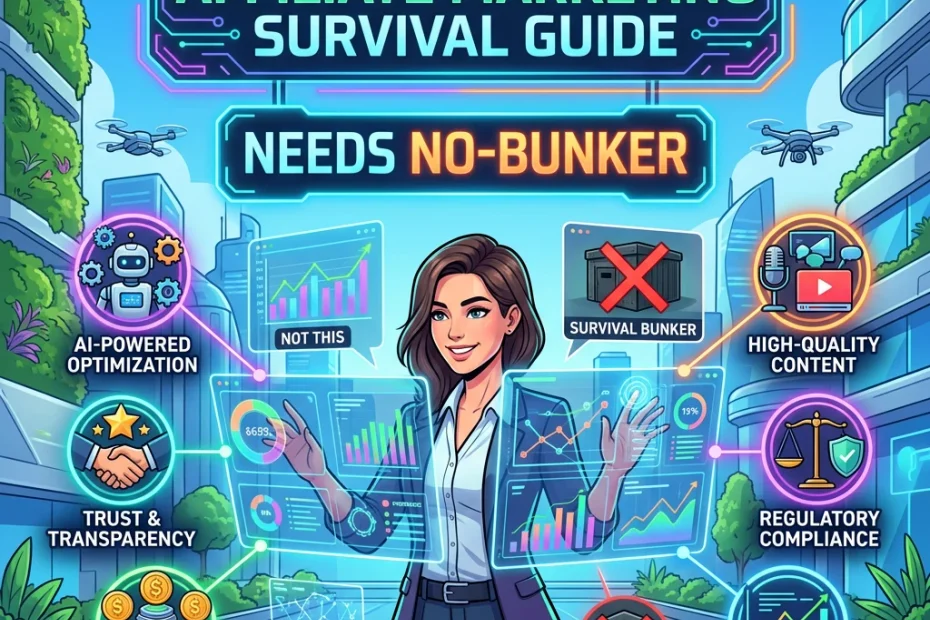
Yes, affiliate marketing will still be here in 2027, and the sites that do best will mostly be the ones that looked after what they already owned. Every article about affiliate marketing trends 2027 will disagree with the others about nearly everything else, so skip the bunker and pack a small survival kit instead.
Will affiliate marketing survive 2027? Short answer, long snack break
Brands pay commissions because they want customers. Readers use affiliate sites because they want help choosing. That arrangement needs a trustworthy recommendation and a link that works, and neither one depends on a prediction.
So pour a coffee and close a few of those tabs. This guide has no forecasts, no percentages and no “the one tool you must adopt by March.” Nobody has reliable numbers about next year, and anyone selling them is selling something else. ☕
What you get is a short list of things to check and restock. It takes a weekend, and it holds up whichever prediction turns out to be right.
Why the panic is louder than the problem
Headlines earn their living by sounding alarming. “Affiliate marketing is changing” gets clicked. “Affiliate marketing is much as it was, so keep your pages accurate” does not.
Picture a blogger who rebuilds her site layout every time a new tool launches. Each rebuild feels productive, but she ends the year with a freshly decorated site and the same eleven articles. Meanwhile, a quieter site down the road fixed its broken links in March, updated its best page in June, and kept sending one useful email a week.
The loud problem is that everything seems to be changing at once. The actual problem is usually smaller: a page that went out of date, a link that died, a visitor who left and had no way to come back. Those are fixable on a Saturday.
What goes in the survival kit (and what stays in the shed)
A good survival kit is small enough to carry and checked often enough that nothing in it has expired. Five items cover most of what an affiliate site needs:
- A flashlight (your own audience). A way to reach people directly, so you are not relying on someone else’s platform to find them.
- A first-aid kit (page repairs). A routine for fixing the pages you already have.
- A water filter (a voice filter for AI). A habit of running every draft through your own opinions so the generic parts get strained out.
- Spare batteries (more than one program). A backup for each of your top earning recommendations.
- A logbook (the 30-minute check). One short, repeatable session where you look at all of the above.
The shed holds everything else: the fourteen plugins you installed to try them, the dashboard you check nine times a day, and the thread of confident predictions from someone with a very shiny profile photo. None of it is evil. It just does not go in the kit until one of the five items needs it.
A simple test for anything new: which of the five items does this help? If the answer is “none, but it looks exciting,” it stays in the shed. 😏
Your own audience is the one thing no update can take away
Search traffic and social reach are borrowed. They can be generous, and they can also change overnight because someone else changed a rule. An email list, a returning reader, a person who types your site name straight into the browser: those are yours, because they live outside anyone’s algorithm.
You do not need a big list to start. You need a reason to join and a reason to stay.
- One clear offer. A short checklist, a comparison table, or a simple “here is what I’d buy and why” email that relates to your niche. Make it specific, because “subscribe for updates” has never convinced anyone.
- One useful message on a steady schedule. Weekly or every two weeks, whichever you can keep up. Consistency matters more than frequency.
- A reply door. Invite people to answer your emails and respond when they do. Those replies tell you which pages to write next.
Vloggers have a similar opening. Video viewers are borrowed in the same way, so give them a place on your website to land: a page that collects your recommendations, with a signup form beside them.
If you want the long-horizon version of building something that lasts, the piece on building a content business that still pays you in 2030 covers it. This one only asks what you can check before spring.
Pages that deserve rescuing before you build new ones
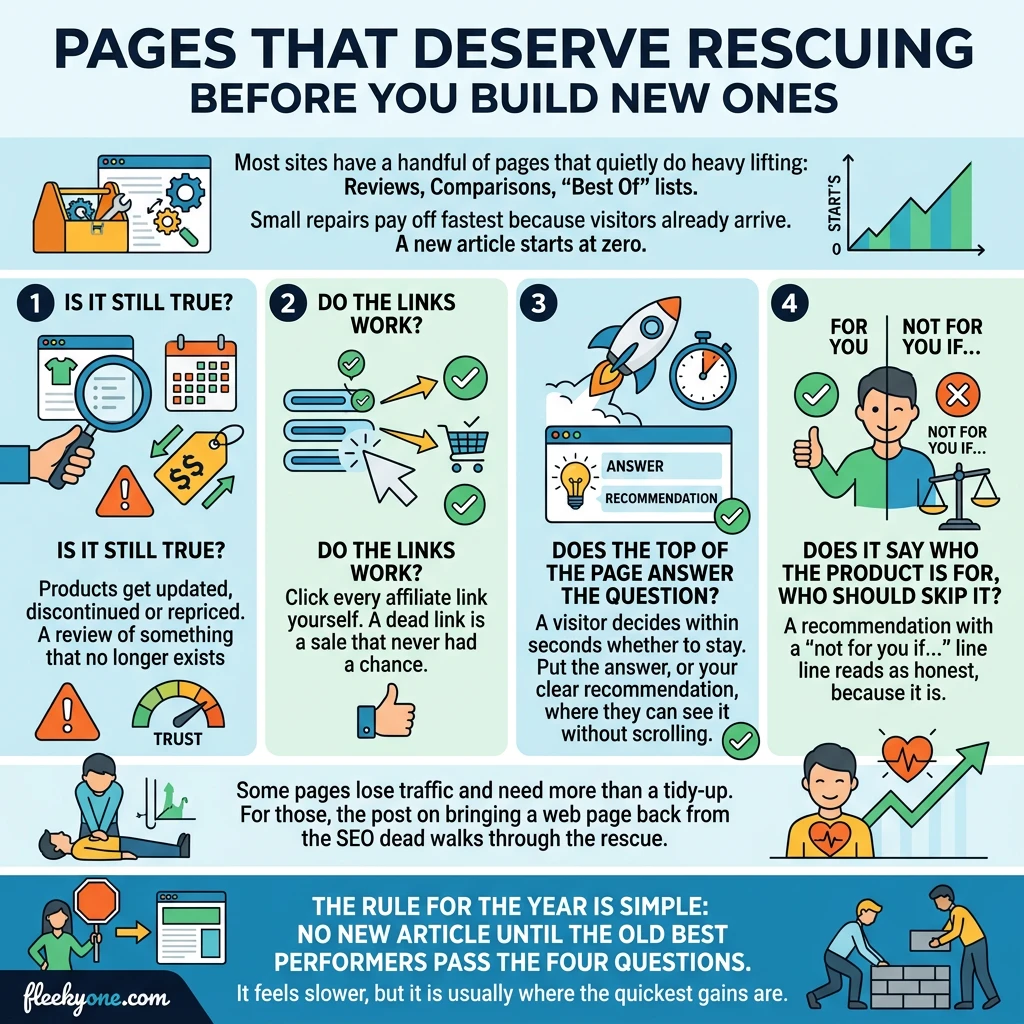
Most sites have a handful of pages that quietly do the heavy lifting: a review, a comparison, a “best of” list. Those are the pages where a small repair pays off fastest, because the visitors already arrive. A new article starts at zero.
Go through your most visited pages and ask four questions about each:
- Is it still true? Products get updated, discontinued or repriced. A review of something that no longer exists costs you trust, and trust is what earns the commission.
- Do the links work? Click every affiliate link yourself. A dead link is a sale that never had a chance.
- Does the top of the page answer the question? A visitor decides within seconds whether to stay. Put the answer, or your clear recommendation, where they can see it without scrolling.
- Does it say who the product is for, and who should skip it? A recommendation with a “not for you if…” line reads as honest, because it is.
Some pages lose traffic and need more than a tidy-up. For those, the post on bringing a web page back from the SEO dead walks through the rescue.
The rule for the year is simple: no new article until the old best performers pass the four questions. It feels slower, but it is usually where the quickest gains are.
Using AI without sounding like everyone else’s website
AI can draft, outline, summarise and suggest. It can do all of that for everyone else too, which is why a lot of websites are starting to sound like the same polite stranger.
The fix is not to avoid the tools. It is to give them something only you have. Before you draft, write down your own position in a few plain lines: what you would recommend, what you would skip, and what a reader might get wrong. Then use the AI to help with structure and speed, and edit the result until your opinions are in it.
A practical filter for every draft:
- Cut any sentence that could appear on any site in your niche. “In today’s fast-paced world” is the usual suspect.
- Add one specific detail the tool could not know. Your own screenshot, your own comparison, your own verdict. Only include what is actually true for you.
- Read it aloud. If you would not say it to a friend over coffee, rewrite it.
Search engines and readers both reward pages that offer something new, and the post on the importance of original content in affiliate marketing goes deeper on why. The short version: AI makes drafts cheap, so the original part is now what a reader is actually choosing your site for.
Affiliate programs? How to stop keeping all your eggs in one basket
A single affiliate program can change its terms, lower its commission, pause an account or close entirely. It does not happen constantly, but it happens, and a site built entirely on one program has no plan for the day it does.
You do not need twenty programs. You need a backup for each of your top earners. Here is a quick way to build one:
- List the five pages that earn the most clicks.
- Next to each, write the program it relies on.
- For any program that appears more than twice, find one alternative product or program that you would honestly recommend in its place.
The keyword is “honestly.” Adding a program you do not believe in just to spread the risk will show in your writing, and readers pick up on it. A backup you can stand behind is worth more than five you cannot.
If you are still choosing programs, the list of best affiliate programs for beginners is a sensible place to compare options. Keep terms and rates checked on each program’s own page, since those details are theirs to set and change.
The same logic applies to where you build. A site you own, hosted somewhere you control, is the base everything else points back to.
A 30-minute survival check you can run this weekend
Set a timer. Open your analytics, your site and a blank note. Here is the whole check:
- Minutes 0 to 5: find your top five pages. Use whatever analytics you have and write the five most visited pages in your note.
- Minutes 5 to 13: click every affiliate link on those pages. Mark anything broken, redirected somewhere odd, or pointing to a product that has changed.
- Minutes 13 to 23: rewrite the opening of the weakest page. Put the answer or recommendation first, add a “who this is for” line, and fix anything out of date.
- Minutes 23 to 27: sign up to your own email list. Use a fresh address if you can. Check that the form works, the confirmation arrives and the welcome message sounds like a person.
- Minutes 27 to 30: name one backup. Pick your top earning recommendation and write down the alternative you would suggest if the program disappeared tomorrow.
Then put the note somewhere you will see it again, and repeat the check next month. The point of a survival kit is that you open it before the emergency, so you know what is in it and whether it still works.
That is the whole plan for the year ahead: five items, one half-hour, and a coffee that has probably gone cold by now.
If you want a home base for building the kit, you can join Wealthy Affiliate through my referral link, or have a look at Kre8or if you’re a vlogger who wants to pair a website with video. Pick the one that fits your setup, and leave a comment telling me which item in your survival kit you’re restocking first. 🔦