

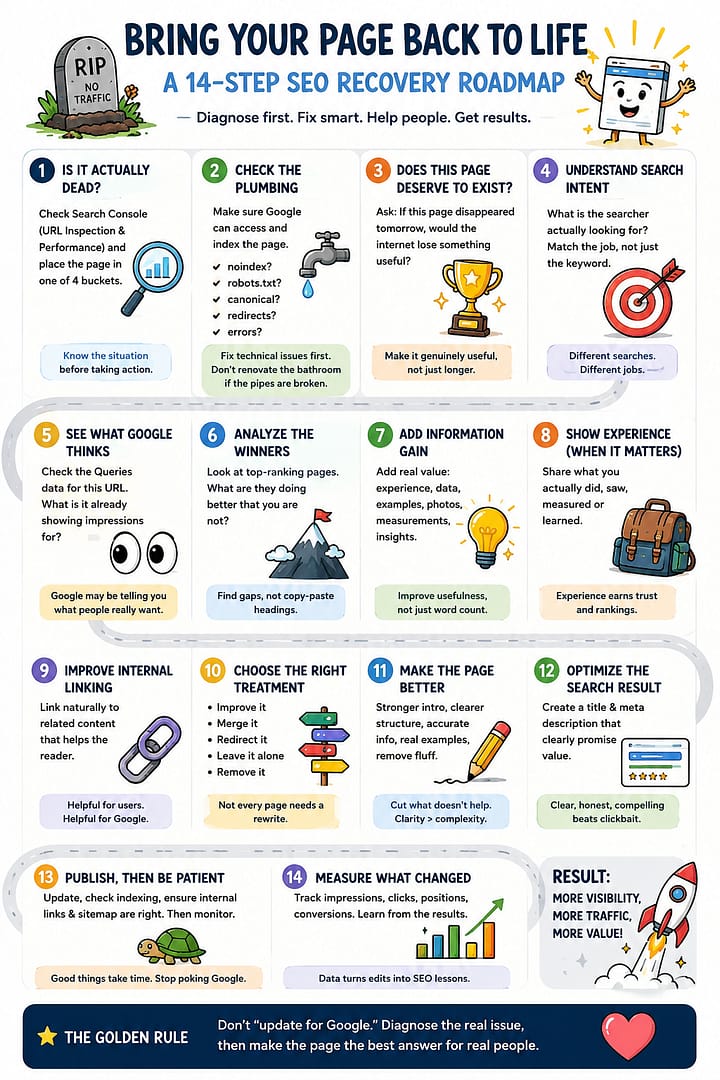
How to Bring a Web Page Back From the SEO Dead
Here’s the framework I’d use for any page that Google seems to have put in the digital basement, whether it’s old, new, updated yesterday, or lovingly written while sacrificing three weekends to the SEO gods.
The practical “diagnose first, fiddle later” approach
The central rule is: Don’t start by rewriting the article. Start by finding out what is actually wrong.
Otherwise, you can spend six hours improving an article whose real problem is a rogue noindex tag. That is the SEO equivalent of renovating the kitchen because the doorbell stopped working.
1. First question? Is the page actually dead?
Before doing anything, establish what Google is doing with the URL. Search Console is your starting point: look at URL Inspection and Performance.
You are trying to place the page into one of roughly five situations:
- Not crawled: Google hasn’t properly visited it. Focus on discovery and crawling.
- Crawled, not indexed: Google knows about it but hasn’t selected it. Diagnose why.
- Indexed, no impressions: Google has it but barely shows it. Investigate relevance, quality and competition.
- Impressions but few clicks: You’re appearing in search. Look at position, title and search intent.
- Used to perform, then declined: Something changed. Start with historical diagnosis.
That distinction is enormously important.
Suppose you publish Best Binoculars for Bird Watching Beginners and Search Console says Crawled – currently not indexed. Rewriting your introduction from 300 words to 150 words isn’t necessarily going to accomplish anything.
We need evidence first.
SEO detective score: 🔎 10/10
2. Check the plumbing before redecorating the bathroom
Before evaluating your prose, eliminate technical stupidity. I use “stupidity” affectionately because websites are remarkably inventive at breaking themselves.
Start with three questions:
- Can Google access the URL?
- Is it indexable?
- What canonical URL does Google recognize?
Then investigate:
- accidental
noindex; - robots.txt restrictions;
- incorrect canonical;
- redirect problems;
- HTTP errors;
- orphaned pages;
- sitemap inclusion;
- duplicate URLs;
- JavaScript/rendering issues where applicable;
- internal links pointing to the page.
Imagine your article is example.com/best-bird-feeders/, but its canonical accidentally points to example.com/bird-feeders/.
Google may effectively be hearing:
“Please index this page.”
“Actually, this other page is the real one.”
Google: 🤨 Pick one.
No amount of adding another 1,500 words about sunflower seeds fixes that.
3. Ask the uncomfortable question: Does this page deserve to exist?
This is one of my favourite SEO tests. Forget keywords temporarily and ask:
If this page disappeared tomorrow, would the internet lose anything useful?
Harsh question. Extremely useful question.
Consider an affiliate site publishing Best Coffee Makers for Small Kitchens. The article begins: Coffee makers are becoming increasingly popular in today’s fast-paced world. There are many different coffee makers available, making choosing one difficult…
Then come eight Amazon products, manufacturer specifications and some affiliate buttons.
Google already has approximately seventeen squillion pages doing this.
Compare that with Best Coffee Makers for Tiny Kitchens: 8 Models Under 8 Inches Wide.
The writer:
- actually measures usable counter space;
- distinguishes width from required clearance;
- checks whether reservoirs can be removed without pulling machines forward;
- photographs machines beneath cabinets;
- identifies models suitable for RVs;
- compares noise;
- explains which machines they tested;
- identifies two products they wouldn’t buy.
Now we have a reason for the page to exist.
That is a much better question than: “Have I used my keyword enough?”
4. Search intent? Google may understand the keyword better than you do
Suppose you target best running shoes for flat feet. You write a fascinating 4,000-word educational article explaining pronation, arches and foot anatomy.
Wonderful article.
But Google predominantly returns product comparisons, tested recommendations, podiatrist-informed selections and shopping-oriented guides. Your informational masterpiece may simply be answering a different question.
Before changing the article, search the query manually. Examine the results and ask:
What kind of page is Google rewarding?
Not so you can photocopy competitors. You’re looking for the underlying intent.
For example:
- how to clean running shoes probably wants instructions;
- best running shoes for flat feet probably wants recommendations;
- Nike Pegasus 43 review probably wants an evaluation;
- Nike Pegasus 43 vs Brooks Ghost 18 probably wants a comparison.
Different searches. Different jobs.
Your page needs to do the job the searcher hired it to do.
5. Find out what Google already thinks your page is about
Here’s where Search Console becomes particularly interesting. Don’t only look at your target keyword; look at Queriesfor that individual URL.
You might discover that your article How to Keep Squirrels Away From Bird Feeders is getting impressions for:
- squirrel proof bird feeder pole;
- bird feeder baffle height;
- how high should squirrel baffle be.
Aha.
Google may be telling you: “People seem particularly interested in the baffle part.”
That’s useful intelligence. Instead of randomly adding another 2,000 words, you might substantially improve that section.
How High Should a Squirrel Baffle Be?
Provide the recommended height, distance from trees and fences, pole diameter considerations, a useful diagram and common installation mistakes.
Now you’re improving something based on actual search behaviour rather than SEO astrology.
6. Compare yourself with the winners — but don’t become their clone
Search your main query and open several strong results. Now ask:
What are they solving that I’m not?
Perhaps competitors include comparison tables, original photographs, pricing context, measurements, FAQs based on genuine questions, first-hand testing, expert quotations, clearer instructions or better examples.
But there is a trap.
If every competitor has sections called:
- What Is X?
- Benefits of X
- How Does X Work?
- FAQs
you don’t automatically need those headings.
That’s how the web ended up containing 40 million articles that all seem to have been written by the same unusually boring committee.
Instead ask:
What could I provide that the current results don’t?
That’s where opportunity lives.
7. Add information gain, not word count
This is perhaps the biggest change I’d make to the classic “update your content” mentality.
Don’t ask: How can I make this article longer?
Ask: What can I add that makes it more useful?
For a travel article about Visiting Lisbon in August, useful additions might include:
- actual midday temperature experience;
- when Tram 28 becomes ridiculously crowded;
- current attraction prices;
- your photographs;
- a sensible walking route;
- where you personally stopped;
- which transport ticket made sense;
- mistakes you made;
- realistic timing.
That’s useful information.
Adding The History of Lisbon, followed by 900 words nobody searching for an August itinerary asked for?
That’s word-count upholstery.
8. Demonstrate experience when experience matters
For reviews, travel, products, tutorials and affiliate content, genuine experience can make an enormous difference to usefulness.
Instead of:
“The backpack has comfortable padded shoulder straps.”
Give me:
“I carried it for four hours with roughly 8 kg inside. The shoulder padding was fine, but the narrow sternum strap started irritating me after about two hours.”
Now I learned something.
Similarly, instead of “Installation is easy,” try:
“The manufacturer says installation takes 20 minutes. Mine took 47 because step six doesn’t explain which direction the bracket faces.”
That is review content.
It isn’t about sprinkling phrases such as “In my experience…” throughout AI-generated prose. Experience should produce information that wouldn’t exist without the experience.
9. Improve internal linking intelligently
Imagine you’ve written Beginner’s Guide to Growing Tomatoes. Elsewhere you have:
- Best Soil for Tomatoes
- How Often to Water Tomatoes
- Tomato Blight Treatment
- Growing Tomatoes in Containers
Those pages should have sensible relationships.
Your watering article could naturally say: “Container-grown plants usually need more frequent watering; see my guide to growing tomatoes in containers for the setup I use.”
Useful to reader.
Useful to crawler.
Useful context.
What I wouldn’t do is manufacture 47 links with identical anchors because someone announced: “Google likes internal links!”
Google also likes websites that aren’t insane.
10. Decide whether improvement is even the correct treatment
Not every weak page should be rewritten. Sometimes the correct answer is to improve it, merge it, redirect it, leave it alone or remove it.
Improve it
The topic is worthwhile and the URL has potential.
Merge it
You have How to Clean White Trainers, Cleaning White Running Shoes and How to Wash White Sneakers.
Congratulations. You may have accidentally created three pages competing for essentially the same job.
One excellent resource might be better.
Redirect it
The old URL has value, but another page has clearly become its replacement.
Leave it alone
The page is indexed, serves its purpose and receives appropriate traffic.
Do not perform SEO surgery because you were bored on Tuesday.
Remove it
Sometimes a page genuinely has no useful purpose.
That’s allowed.
11. Now — and only now — improve the article
At this stage, we know why we’re editing.
Work through:
- Opening: Does it answer the searcher’s problem quickly?
- Structure: Can someone skim it and find what they need?
- Accuracy: Anything obsolete?
- Evidence: Are claims supported appropriately?
- Experience: Can we add genuine observations?
- Originality: What does this provide that isn’t available everywhere else?
- Completeness: Are important questions unanswered?
- Brevity: What can we remove?
That last one gets neglected.
Sometimes improving an article means deleting 1,200 words.
Google does not award medals for endurance.
12. Don’t forget the search result itself
Your article can be good while its search presentation is dreadful.
Suppose Google shows:
Best Coffee Makers – Coffee Maker Buying Guide 2026
Meh.
Compare:
7 Coffee Makers That Actually Fit Under Small Cabinets (2026)
Much clearer proposition.
But don’t turn titles into clickbait circus acts:
🚨 YOU WON’T BELIEVE WHICH COFFEE MAKER DESTROYED THE COMPETITION!!! 😱
We’re selling coffee machines, not revealing who murdered Lord Featherington.
Your title should accurately communicate why this result is worth clicking.
13. After publishing, don’t immediately poke Google with a stick
Update the page, make sure it is internally linked appropriately, and confirm the sitemap, canonical and indexability situation is correct. URL Inspection can be useful, including requesting indexing where appropriate.
Then monitor.
Don’t update at 10:04 a.m. and search your keyword at 10:17:
“WHY AM I STILL NUMBER 43?”
SEO rarely provides instant gratification.
Track the URL’s performance over a meaningful period. Look at:
Impressions → average position → clicks → queries → landing-page traffic
And, much more importantly for a commercial site:
Conversions/revenue.
Ranking #1 for something nobody buys is an excellent way to become a very successful charity.
14. Measure what actually changed
This is the part many SEO tutorials mysteriously forget.
Record a baseline before making major changes. For example:
| Metric | Before | After |
|---|---|---|
| Indexed | Yes | Yes |
| Monthly impressions | 8,400 | 14,700 |
| Clicks | 126 | 291 |
| Avg. position | 17.8 | 10.4 |
| Affiliate clicks | 31 | 76 |
| Sales | 2 | 7 |
Now you can learn from the experiment. Even failure becomes useful.
If impressions increase dramatically but clicks don’t, perhaps rankings, title or intent need work. If clicks increase but sales don’t, perhaps your commercial recommendation or traffic intent is wrong. If nothing changes, your hypothesis may have been wrong.
That’s SEO, rather than ceremonial content editing.
🩺 My SEO Triage System
For any struggling URL, I’d go in this order:
- Is it accessible?
- Is it indexable?
- Is it actually indexed?
- Is Google showing it for anything?
- Does it satisfy the intended search?
- Is there a convincing reason for this particular page to exist?
- Does the site support it through architecture and internal links?
- Should we improve, merge, redirect, retain or remove it?
- Make the intervention.
- Measure the result.
That ordering matters.
The philosophy in one sentence
Don’t “update content for Google.” Diagnose why a page isn’t succeeding, then make it substantially more useful for the people Google is trying to serve.
That’s the approach I’d use whether the article was published eight years ago or eight days ago.
Ready to turn your passion into profit?
Join Wealthy Affiliate and learn step-by-step how to promote WA (and apply the same strategies to any niche).
👉 Build skills.
👉 Grow traffic.
👉 Create success on your terms.
Your journey starts here. Why not today?


