

Teamwork Makes the Dream Work (But Only If Nobody “Replies All” at 2 A.M.)
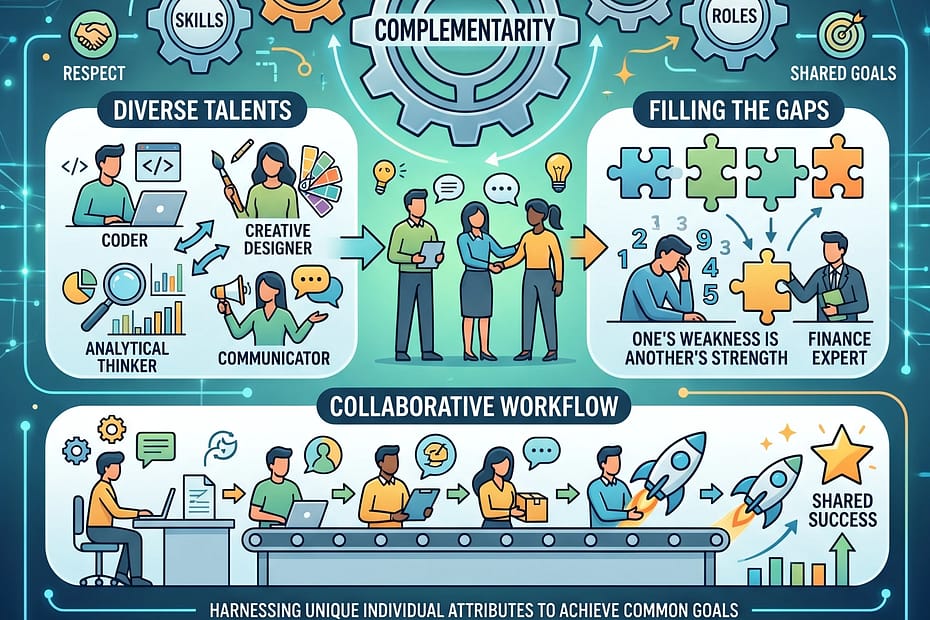
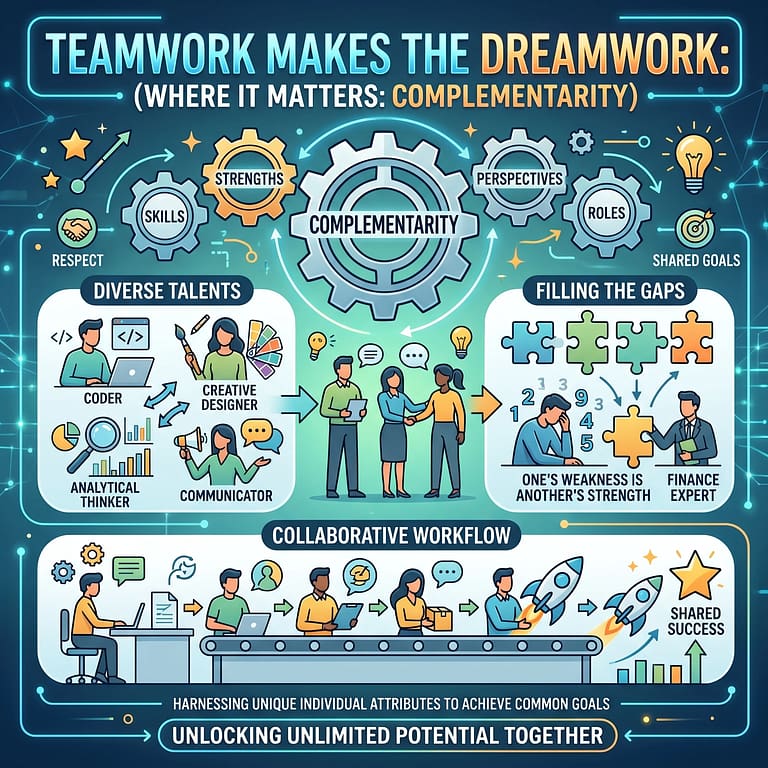
Let’s create a concept called “Teamwork Makes the Dream Work” based on this infographic.
There’s a magical moment in every online business when a group of wildly different humans somehow stops acting like caffeinated raccoons and starts operating like a championship team.
That moment is called complementarity. The beautiful business phenomenon where one person’s “I have absolutely no idea how to do that” becomes another person’s “Oh, I built three of those before breakfast.”
And honestly?
That’s the entire secret behind successful content brands, online businesses, startups, and creative teams.
The infographic says it perfectly:
“Harnessing unique individual attributes to achieve common goals.”
Translation:
The designer shouldn’t be doing accounting.
The accountant shouldn’t be writing Instagram captions.
And nobody should let the intern “just wing” the email automation sequence.
The Myth of the Solo Genius
The internet loves the myth of the lone entrepreneur.
You know the type:
* Writes all the blogs
* Designs the website
* Edits the videos
* Runs the ads
* Answers customer emails
* Manages SEO
* Makes TikToks
* Somehow still “journals at sunrise”
Meanwhile, in reality, they’re one Canva crash away from emotional collapse.
The truth?
Most successful online businesses are powered by diverse talents working together.
Exactly like the infographic shows:
* The coder builds the system.
* The creative designer makes it beautiful.
* The analytical thinker asks, “But what do the numbers say?”
* The communicator translates chaos into clarity.
Individually, they’re talented.
Together, they become dangerous.
In a good way.
Every Dream Team Has “The Spreadsheet Person”
Let’s be honest.
Every online business has:
1. The visionary
2. The executor
3. The chaos goblin
4. The spreadsheet wizard
And if your team doesn’t have a spreadsheet person…
…you are the spreadsheet person now.
The infographic highlights a critical truth:
“One’s weakness is another’s strength.”
This is why the best teams don’t compete internally.
They compensate strategically.
Example:
A content creator says: “I just want to inspire people.”
The operations manager says: “Wonderful. But first, please invoice the client.”
A copywriter says: “I wrote a 4,000-word masterpiece.”
The SEO strategist says: “Amazing. Unfortunately, nobody is searching for that keyword.”
A designer says: “Minimalism is elegance.”
The marketer says: “Yes, but can the audience find the BUY button?”
That friction isn’t dysfunction.
That’s teamwork.
Complementarity = The Real Business Superpower
The infographic places COMPLEMENTARITY right in the center … and for good reason.
Because high-performing teams are not built on sameness.
They’re built on:
* Different strengths
* Different perspectives
* Different roles
* Shared goals
This matters especially in online business.
Why?
Because digital business is weirdly multidisciplinary.
Running a content brand today means simultaneously becoming:
* A storyteller
* A strategist
* A psychologist
* A data analyst
* A customer service rep
* A part-time thumbnail philosopher
No single human dominates all of those areas.
And the ones who try usually end up whispering:
“Maybe I should open a bakery instead…”
The “Filling the Gaps” Principle
One of the smartest sections of the infographic is the puzzle-piece concept: Filling the Gaps
That’s elite teamwork in one visual.
The strongest teams are not made of clones.
They’re made of people who:
* Offset blind spots
* Challenge assumptions
* Bring missing skills
* Catch mistakes before Twitter does
Example From Content Creation
Imagine launching a YouTube channel.
Without a Team:
You:
* Film badly
* Edit slowly
* Forget audio
* Write weak titles
* Burn out in 3 weeks
With Complementary Teammates:
* Writer creates compelling scripts
* Editor makes videos dynamic
* Thumbnail designer increases clicks
* SEO strategist improves discoverability
* Community manager builds loyalty
Suddenly:
Your “little channel” becomes a media brand.
That’s the dream work part.
Respect = The Most Underrated Business Skill
Notice how the infographic quietly includes RESPECT?
That’s not decoration.
That’s infrastructure.
Because collaboration dies the second people think:
“My role matters more than yours.”
The best online teams understand:
* The writer needs the editor
* The editor needs the strategist
* The strategist needs the data analyst
* The analyst needs the communicator
* Everyone needs the coffee person
Especially the coffee person.
A team becomes elite when people stop protecting ego and start protecting outcomes.
Collaborative Workflow Or “How Projects Stop Becoming Dumpster Fires”
The bottom section of the infographic shows a production-line workflow leading to rockets and shared success.
That’s basically every successful content business ever.
Great content isn’t random inspiration.
It’s a process.
Example Workflow:
1. Strategy brainstorm
2. Research
3. Writing
4. Editing
5. Design
6. Publishing
7. Promotion
8. Analytics review
9. Improvement cycle
Without workflow:
Chaos.
With workflow:
Scalability.
The rocket ships in the infographic are accurate
because organized collaboration really does feel like launch velocity.
Shared Goals Matter More Than Shared Personalities
One of the biggest misconceptions about dream teams:
People think everyone must think alike.
Actually, the opposite is true.
The strongest teams often include:
* Introverts
* Extroverts
* Creatives
* Analysts
* Fast movers
* Careful planners
What unites them is not personality.
It’s mission alignment.
The infographic nails this with: Shared Goals
Because if everyone is committed to the same outcome, different perspectives become an advantage instead of a conflict.
Online Business Reality Check
Let’s say this clearly:
Most online businesses fail not because people lack talent…
…but because:
* nobody communicates,
* roles are unclear,
* systems are weak,
* expectations are vague,
* and Steve keeps redesigning the homepage every Thursday.
A dream team is not: “a group chat with ambition.”
It’s:
* structured collaboration,
* role clarity,
* mutual trust,
* and complementary strengths.
Conclusion? The Best Teams Multiply Talent
A great team doesn’t just add skills together.
It multiplies them.
That’s the deeper message hidden inside the infographic.
When complementary people unite around a shared mission:
* creativity improves,
* execution accelerates,
* blind spots shrink,
* and results compound.
Or said differently:
A solo creator can make content.
A dream team can build a movement.
And preferably one with fewer emergency Zoom calls…