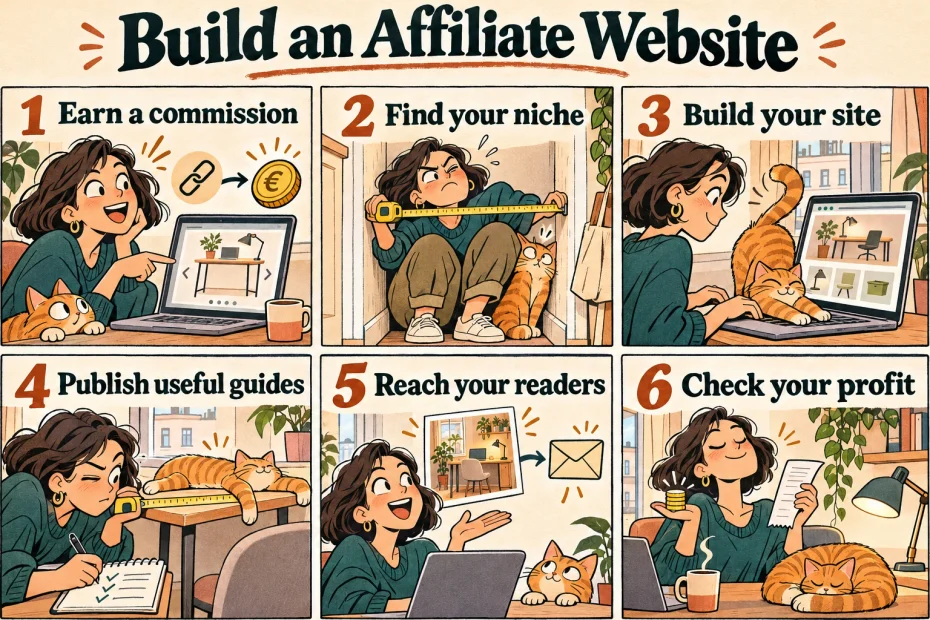
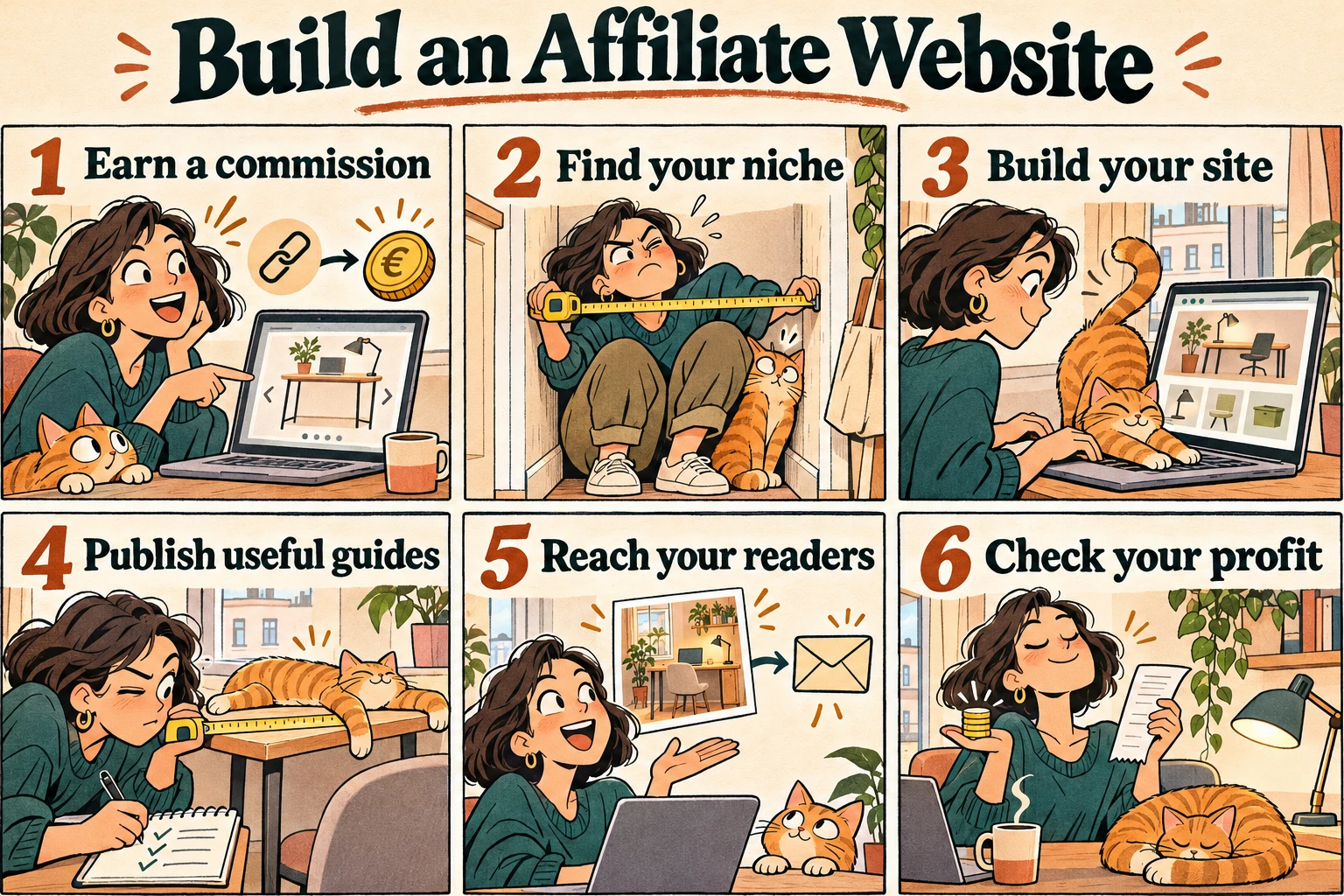
Step-by-Step Guide to Build a Profitable Affiliate Marketing Website
Build your site around a question people ask before they buy. Give them an answer they can use, then recommend a product if it helps.
Say you want a home office, but all you have is a spare corner and €150. You could spend an evening scrolling through desks. Or you could find one article that tells you what fits, what you can reuse, and whether that lovely wall-mounted desk will cost you your rental deposit.
That’s the sort of article an affiliate website can build a business around.
1. How does an affiliate website make money?
There are three people in the deal. A merchant sells the product, you recommend it, and the reader decides whether to buy. If the program credits a qualifying sale or action to your link, you earn a commission. Simple, right? The fine print has a few more pages.
| Payment model | What earns a commission |
|---|---|
| Revenue share | You receive a percentage of a qualifying sale. |
| Cost per action (CPA) | A reader completes a specified action, such as a purchase, signup, or trial. |
| Cost per click (CPC) | The program pays for eligible clicks. Check whether the program offers this model. |
You can start small because the merchant handles the product and fulfils the order. Your part takes time. You research products, write useful articles, and revisit old recommendations when prices, stock, or terms change. A good article can earn long after publication. It may still need a fresh link on Tuesday.
2. What can your site help people decide?
Start with a topic you know or want to explore in depth. Then give it edges. Home office furniture could fill a warehouse. Affordable home offices for renters with small rooms gives you someone to write for and a problem to solve.
Search for questions your reader might ask. What desk fits in a shallow alcove? Can I raise my laptop without buying a stand? Which desks fold away at the end of the workday? Read the pages that come up and look for gaps. If every desk roundup gives you the width but skips the depth, you’ve found a detail worth a tape measure. Tools such as Moz or Ahrefs can help you expand your list of search terms.
Next, check which merchants serve that audience. Read the program terms for commission rates, payout rules, returns, and restrictions on promotion. Check where the merchant ships and what customers say about delivery and support. A generous commission looks lovely on paper. Your reader still has to get the desk through the door.
Give yourself a first milestone you can control. Publish one main guide and two articles that answer specific follow-up questions. Note your costs from day one so you can judge profit once sales come in.
3. What does your WordPress site need at launch?
Choose a domain you can say aloud without having to spell it twice. If you go with self-hosted WordPress, choose a host, install WordPress, and pick a lightweight theme. Wix and Squarespace are also options if you prefer to handle the site and hosting in one place.
Give readers a short menu, a clear home page, and an About page that explains who the site serves. Add a way to contact you. Open the site on your phone and try to find an article, read the text, and tap a link. If the menu hides behind a pop-up, you’ve found your first repair.
Check what your host already covers for backups, security, and performance before you add plugins. If you want help with page titles and descriptions, an SEO plugin such as Yoast can handle those basics. Then publish the first article. You can spend a surprising amount of time deciding on a shade of blue for a site with nothing to read.
4. What should you publish first?
Write the article you wish you’d found before you pulled out your wallet. For the home office site, that could be a guide to setting up a workspace under €150. Show readers what they can reuse, what to measure, and where a purchase could make the biggest difference. Link to a comparison of desks for tight spaces and a tutorial on how to set up a corner without drilling holes.
Google’s E-E-A-T framework stands for experience, expertise, authoritativeness, and trust. In practice, let readers see how you reached your verdict. If you tried a desk, say what you measured and what wobbled. If you compared published specifications, say so and point readers to them. A clear drawback can make a review more useful than a fifth star.
Use a title that matches the question, break up the article with useful headings, and link to the next relevant guide. Put a plain-language disclosure where readers can see it before they encounter affiliate links. I may earn a commission if you buy through links in this article tells them what they need to know.
Pick a pace you can keep. One article that settles a real question gives readers a reason to return. A calendar full of nearly identical roundups gives you a reason to lie down.
5. Where will your first readers come from?
Start with one place your readers already spend time. A photo of a real desk squeezed into a narrow alcove might work on Pinterest or Instagram. In a relevant Facebook group, you could answer someone’s question about desk depth and share your guide if the group allows links.
Email gives readers a way back. Send one tip worth opening, such as a short checklist of measurements to take before they order a desk. The next email can answer a question a reader sent you. Those questions can also tell you what your site still lacks.
If you test paid ads or sponsored placements, check the affiliate program’s terms, cap your spend, and track commissions from the campaign. A busy page can still lose money.
6. How do you tell if the site is profitable?
Use Google Search Console to see which searches bring people to your pages. Use your site analytics to see which pages they visit and which affiliate links they click, if you track those clicks. Then check the affiliate dashboard for credited sales and approved commissions. Each report answers a different question.
| What you see | What to check first |
|---|---|
| Few readers find the guide | Check whether the page is indexed and whether its title matches the reader’s question. |
| People read the guide but rarely click a product link | Check whether the product fits the problem and whether readers can find the link. Some readers may have solved the problem with what they already own. |
| Readers click through but few sales appear | Check that the link tracks correctly, the product is in stock, and the merchant ships to your audience. |
| Sales come in but costs eat the commissions | Compare approved commissions with hosting, tools, ads, and other expenses. Track your time separately so you can judge whether the return is worth the effort. |
When a page earns steadily, keep it useful and follow the next question. If the guide to narrow desks brings readers in, they may also need a lamp that leaves room for a coffee cup. You can test a second merchant or cover a related problem without wandering into a whole new niche.
For your first article, find one person with one awkward corner and one budget. Help them work out what fits before they buy. If the answer is to move the table they already own, tell them. They’ll know whose guide to look for when they do need a desk.

Ready to turn your passion into profit?
Join Wealthy Affiliate and learn step-by-step how to promote WA (and apply the same strategies to any niche).
👉 Build skills.
👉 Grow traffic.
👉 Create success on your terms.