Six Months In and Zero Dollars? What Actually Helps
Slow or no income
Yes, six months without a first commission is common for a new site. The zero on your dashboard hides which of three numbers is too small, and finding that number is the most useful work you can do right now.
Is six months with no commission normal?
For a site that is still young, yes. A weekly publishing schedule gives you roughly two dozen articles in six months, and many of those are only a few weeks old. They may not yet show up well in search, and a page nobody finds earns nothing.
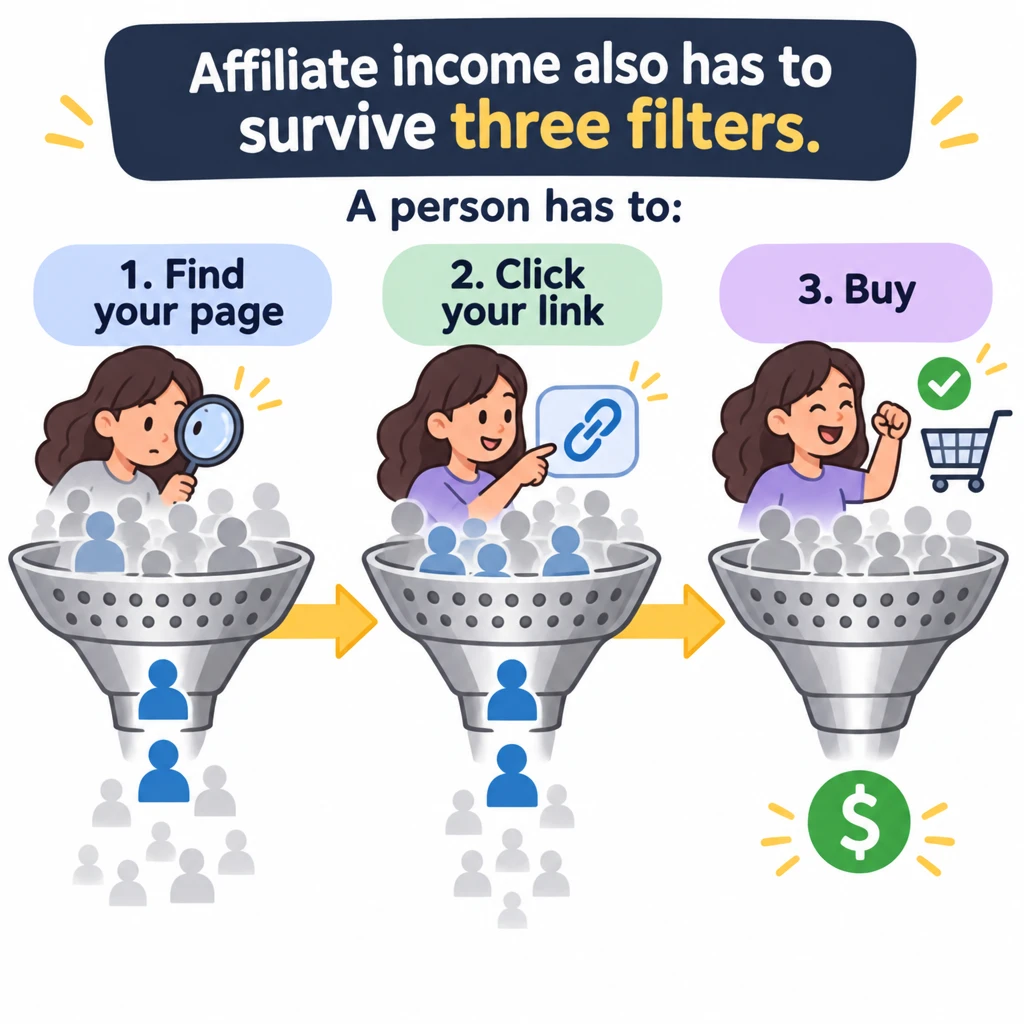
Affiliate income also has to survive three filters. A person has to find your page, click your link, and then buy. Each filter loses most of the people who reach it. When your traffic is small, three small numbers multiplied together often come to less than one sale. The sums produce a zero without anything being wrong with you.
That is useful to know, because a zero from small numbers and a zero from a real problem call for different responses. The next section is about telling them apart.
Where is the money actually stuck? Visitors, clicks or buyers?
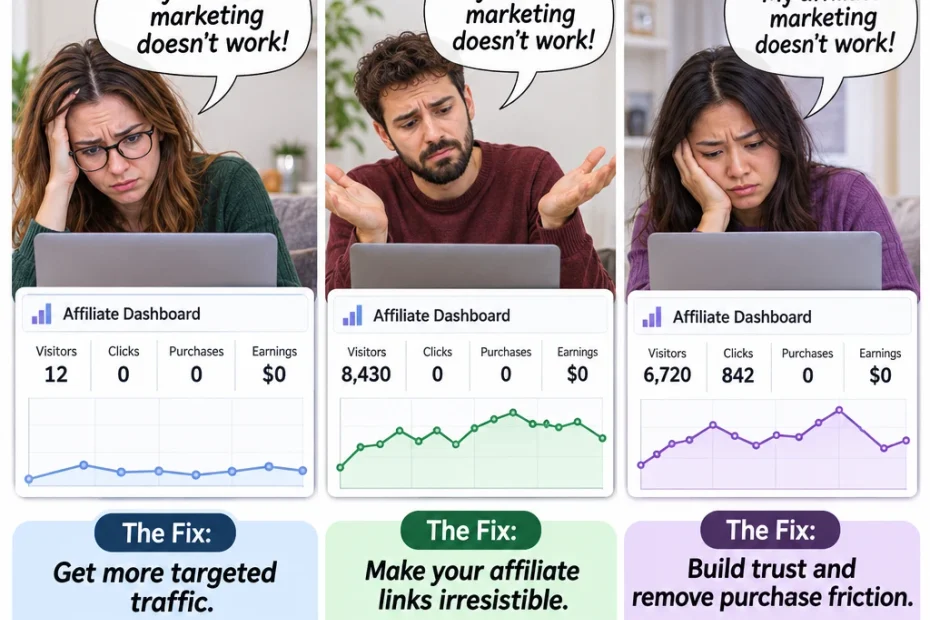
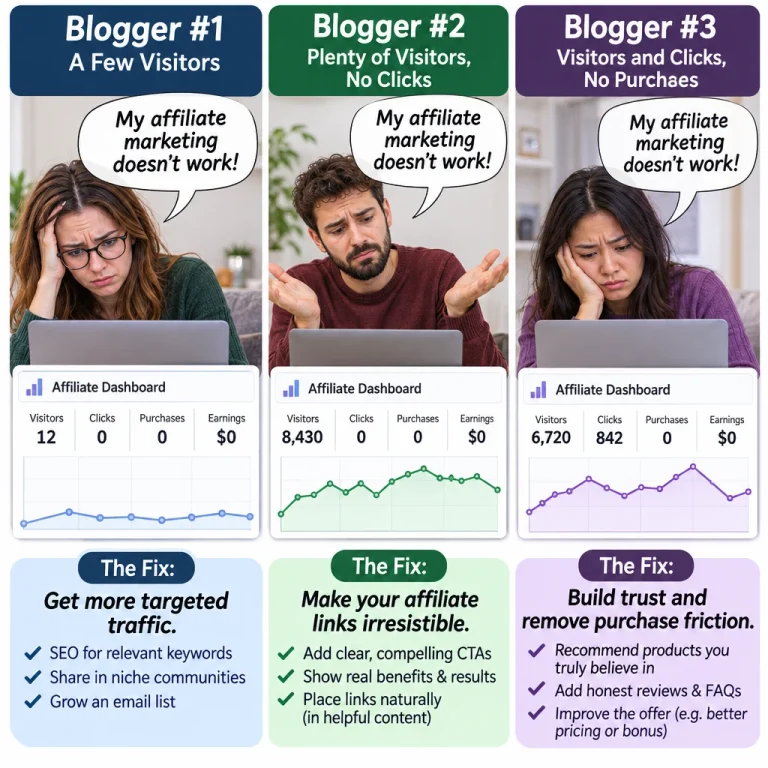
Picture three bloggers with the same empty dashboard. The first has a handful of visitors a month. The second has plenty of visitors, but nobody touches the affiliate links. The third has visitors and clicks, and nobody buys. All three would say “my affiliate marketing doesn’t work,” and they would need three different fixes.
Check each stage in order.
- Visitors. Open your site analytics and look at monthly visits, then at which pages get them. If the total is in the dozens, the stuck point is visitors, and nothing further down the line matters yet.
- Clicks. Most affiliate programs show a click count in their own dashboard. Compare it with the visits on the pages that carry the links. Plenty of visits and almost no clicks means the links are in the wrong place or the page never makes a case for the product.
- Buyers. Clicks without purchases mean readers arrive at the product and leave. The cause could be a mismatch between what your article promised and what the product page delivers, or a reader who was not ready to buy.
Be strict about the order. Fixing your link buttons when only twelve people visited last month is like repainting the shop sign on a street nobody walks down.
If clicks are your sticking point, the piece on why affiliate links get clicks and nobody buys goes into that stage in more detail.
What should you keep doing when the dashboard says zero?
Keep publishing, but aim each article at one specific question a real person would type into a search box. “Best tools for bloggers” is a crowded room. “Which tool lets me schedule posts without paying monthly” is a narrow door, and fewer people are standing in it.
Keep going back to older articles too. A post from three months ago can be improved with a clearer opening, a better answer, an honest note on who a product suits and who it does not. That is often a better use of an evening than a brand new post.
Keep your affiliate links on pages where a reader is making a decision. A review, a comparison or a how to that needs a tool all qualify. A general essay that happens to mention a product in passing rarely produces a click.
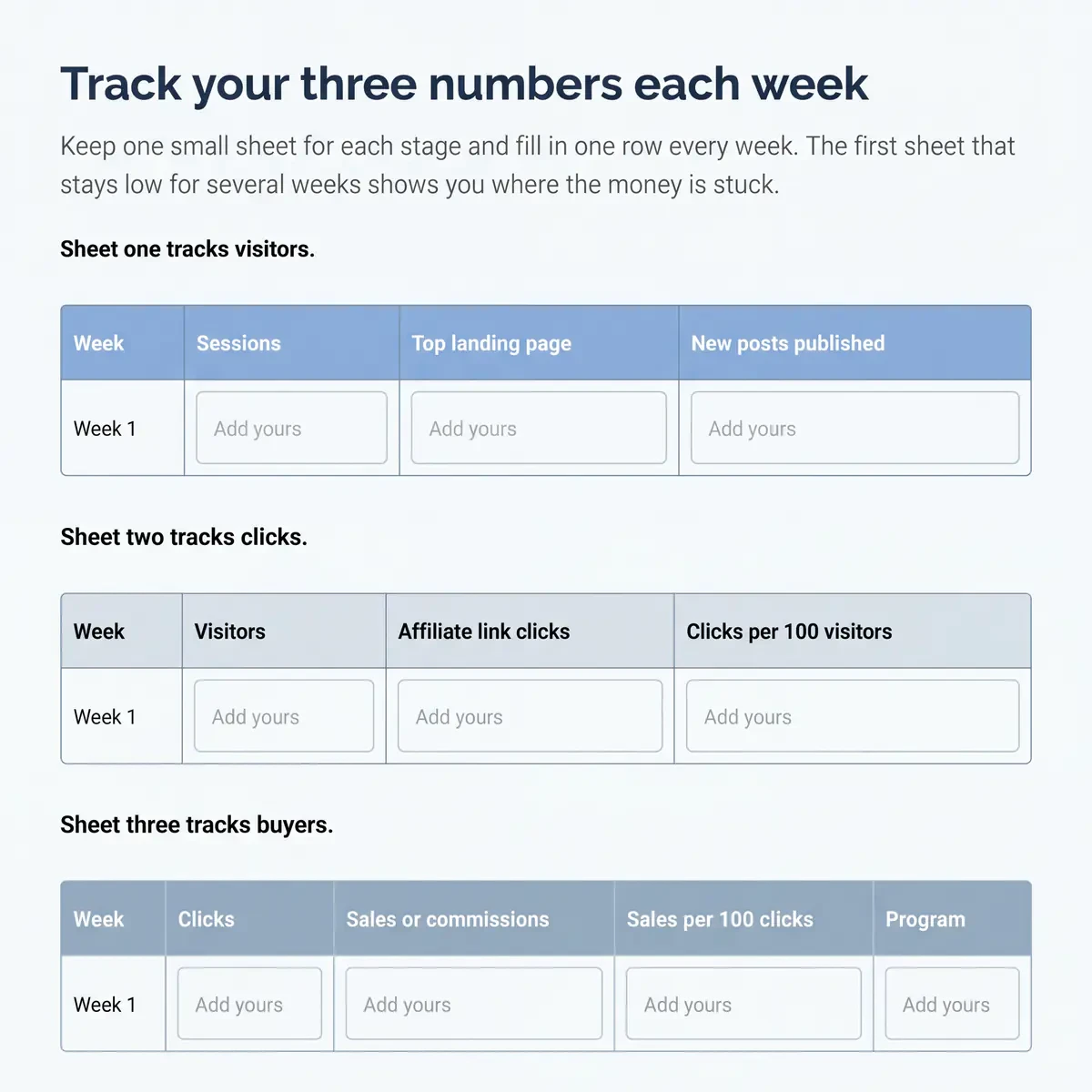
Keep a simple weekly record. Write down visits, clicks and sales once a week, in the same place, on the same day. Three numbers and a date are enough. After a couple of months you can see movement that a daily glance would hide, and you stop treating every wobble as news.
Keep your review pages honest. Readers can tell when every product is “amazing.” A review that says who should skip the product earns more trust than one that sells to everybody, and trust is what a reader needs before clicking a link from a site they have only just met.
What should you stop doing?
Stop the midnight homepage rewrite. It feels like progress, because you are touching the site and the screen changes. But most readers arrive through articles, not the homepage, so a new headline there reaches very few of them. If you change five things at once, you also cannot tell afterwards which one mattered. A homepage wants one good afternoon, not forty small panics at 1 a.m. ☕
Stop collecting shiny tactics. Every week a new method promises to fix traffic, and every one of them takes a month to learn and a few more to judge. If you start a new one before the last has had a fair run, you never get an answer from any of them. Pick one change, give it a defined window, and write down what you expect to happen.
Stop refreshing the dashboard. Affiliate numbers do not move because you stare at them. Checking six times a day teaches you only how it feels to see zero six times a day.
Stop reading other people’s income screenshots as a measure of your own pace. You see their best month, cropped, with nothing about how long it took or how large their audience was. Compare your own numbers this month with your own numbers last month, and leave the rest alone.
Stop deleting things that are slow. An article that has had no visits for six weeks is not necessarily a failure. Plenty of pages sit quietly before search engines notice them. Improve it, link to it from your other pages, and leave it up.
How do you stay sane while you wait?
Measure what you control. You cannot control whether someone buys this week. You can control whether you publish an article, improve a weak page or answer a comment. Put those on a short weekly list and tick them off. A list you can finish gives the week a result, even when the dashboard does not.
Look for small proof instead of big proof. The first visit from a search engine counts. So does the first comment from a stranger, the first click on an affiliate link, or the first email asking a question. None of these pays anything, and each one shows a stage in your funnel starting to work. Note them down and look at the list when the zero gets loud.
Set limits on the checking. One review day a week is plenty, and the other six days are for building. If you notice the urge to look at stats at 11 p.m., close the laptop and go and do something dull… washing up works well.
Find company. Building a website is a solitary job, and zero feels worse when nobody else can see the screen. A community of people at the same stage helps you hear “mine was empty too, here is what I looked at” instead of imagining that everyone else got a commission in week three.
And allow yourself to be bored sometimes. Slow stretches are mostly repetition. Publish, improve, check, repeat. It is dull work that adds up, and it is the part of the job nobody puts in a screenshot.
When is it time to change something, and what first?
Decide the review date in advance. Pick a point, say eight weeks out, when you will look at the numbers calmly and make one decision. Before that date you can keep building, but you do not change direction. After it, you act on what the numbers show.
Then change one thing, and let the stuck stage decide what.
If visitors are the problem, write more narrowly. Choose questions that are specific and answerable, and write the most useful answer on the web for that question. Link your new articles to each other and to your older ones, so a reader who lands on one has a reason to open another. Also check that your pages can be found at all, meaning that the site is indexed and the titles say what the article covers.
If clicks are the problem, move your recommendation closer to the point where the reader needs it. Say in plain words what the product does for them and who it suits. Use a clear link on natural wording, instead of a vague “click here” at the bottom of a page. Make sure the pages with links are the pages that actually get visits.
If buyers are the problem, reread your article from the point of view of someone who clicked. Does the product page match what you promised? Is the price or the sign up process a surprise? Does your article answer the doubt a buyer would have at that moment? Also read the program’s terms, because some only count a purchase made within a set time after the click.
If you have changed the stuck stage, waited out the window, and the number has not moved, the next question is bigger. Does your topic have people who buy the thing you recommend? A niche with plenty of readers and no products worth paying for may need a different angle. That is a decision for after a proper test, though, and not for 1 a.m. on a bad Tuesday.
Over to you
Which stage is your income stuck at right now, visitors, clicks or buyers? Tell me in the comments, and give a rough number if you are happy to. It helps to see where everyone else is sitting.
If you would like company while you build, I build with WA and Kre8or, and I am happy to share my referral link if you ask. I can’t promise earnings, and nobody honest can, but I can promise a friendly voice in the comments.