

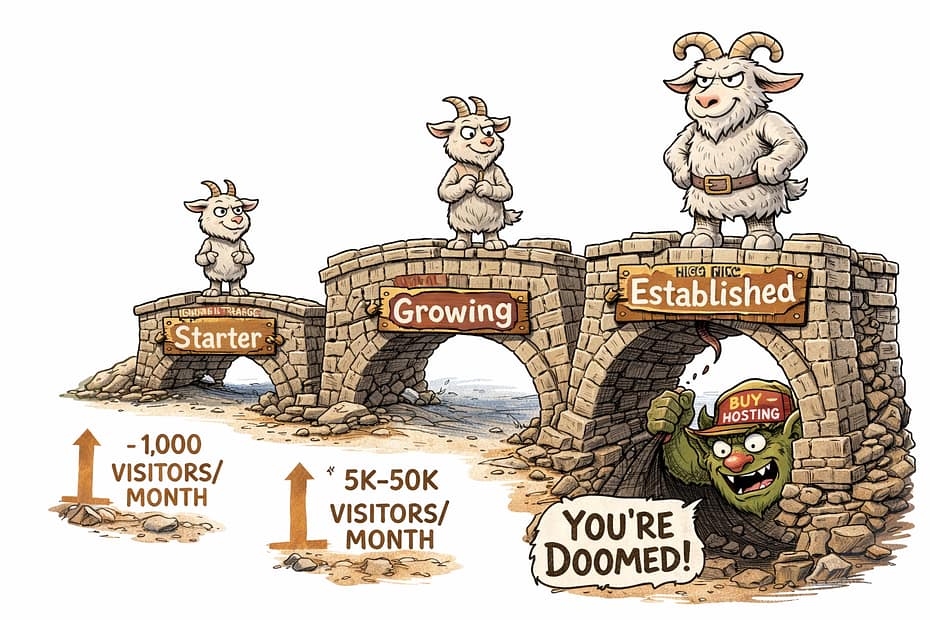
3 Goats and Their Hosting Bridges
Where Each Goat Should Actually Host and Why
The bridges are visible. Now comes the real question: Where should each goat actually host? Let’s walk it stage by stage.
🐐 Little Goat.
The Starter Bridge
Profile:
- 0–1,000 visitors/month
- First blog or project
- Learning WordPress (or another CMS)
- Limited budget
- Limited technical experience
What Little Goat Needs:
- Easy setup
- One-click installs
- Decent uptime
- Basic support
- Low cost
- No server management stress
Best Hosting Options:
1️⃣ Reputable Shared Hosting
Good for:
- Budget-conscious beginners
- Simple blogs
- Portfolio sites
Pros:
- Affordable
- Easy to manage
- Often bundled with email + domain tools
Tradeoffs:
- Limited resources
- Slower under heavy load
- Performance varies by provider
This is fine for starting. Truly.
2️⃣ Managed WordPress Hosting (Entry Level)
Good for:
- Beginners who want fewer technical worries
- Faster performance than basic shared hosting
Pros:
- Optimized environments
- Automatic updates
- Better caching setups
- Often better support
Tradeoffs:
- Higher cost than shared
- Less flexibility than VPS
If budget allows, this is often the “less stressful” path.
❌ What Little Goat Does NOT Need:
- VPS
- Dedicated servers
- Kubernetes
- Cloud clusters
- A DevOps consultant named Lars
At this stage:
Publish first. Optimize later.
🐐 Middle Goat.
The Growing Bridge
Profile:
- 5K–50K visitors/month
- Monetization starting
- SEO matters
- Speed matters
- Security matters
Now hosting becomes strategic.
What Middle Goat Needs:
- Better performance
- More consistent speed
- Resource isolation
- Staging environments
- Stronger backups
- Better caching
Best Hosting Options:
1️⃣ High-Quality Managed Hosting
Ideal for:
- Growing blogs
- Affiliate sites
- Small businesses
- Membership platforms
Pros:
- Performance-optimized stacks
- Good caching layers
- Expert support
- Security features included
Tradeoffs:
- Costs more
- Less root-level control
This is the “focus on growth, not servers” option.
2️⃣ Managed VPS
Ideal for:
- Users comfortable with some technical complexity
- Projects requiring custom setups
Pros:
- Dedicated resources
- More flexibility
- Scalable
- Better performance consistency
Tradeoffs:
- Requires technical knowledge
- Misconfiguration risks
- Maintenance responsibility
This is for the technically confident Middle Goat.
❌ What Middle Goat Should Avoid:
- Cheap oversold shared hosting
- Hosting chosen purely by coupon size
- Panic upgrades to enterprise cloud “just in case”
Growth should be intentional — not reactive.
🐐 Big Goat.
The Established Bridge
Profile:
- 100K+ visitors/month
- Revenue-dependent site
- Brand reputation at stake
- Traffic spikes possible
- Performance impacts income
Now hosting is infrastructure.
What Big Goat Needs:
- Scalability
- Load balancing
- Advanced caching
- Redundancy
- Monitoring
- Hardened security
- Disaster recovery planning
Best Hosting Options:
1️⃣ High-End Managed Cloud Hosting
Ideal for:
- High-traffic publishers
- E-commerce sites
- Revenue-heavy platforms
Pros:
- Auto-scaling
- Optimized cloud infrastructure
- Built-in performance layers
- Monitoring tools
Tradeoffs:
- Higher cost
- More complex billing structures
2️⃣ Custom VPS / Cloud Architecture
Ideal for:
- Tech-savvy operators
- Agencies
- SaaS founders
- Businesses needing custom stacks
Pros:
- Full control
- Infrastructure flexibility
- Cost optimization at scale
Tradeoffs:
- Requires DevOps expertise
- Higher responsibility
- Security must be actively managed
At this level: Hosting is part of your business strategy.
🧌 And What About the Troll?
The troll screams: “THIS HOST IS TRASH.”
But never clarifies:
- For what traffic?
- For what stack?
- For what budget?
- For what technical ability?
The real answer to “Where should I host?”
Is: Where are you in your journey?
Not: What host is trending this week?
🏗 The Bridge Decision Framework
Before choosing hosting, every goat should ask:
- What’s my actual traffic?
- What’s my growth projection?
- How technical am I?
- What happens if my site goes down?
- Is revenue dependent on uptime?
Match infrastructure to reality.
Not ego.
Not fear.
Not discount codes.
🌉 Hosting Comparison Tabke
Which Bridge Fits Which Goat?
Not all bridges are built for the same weight.
Here’s a clear side-by-side look at what actually fits each stage.
| 🔎 Category | 🐐 Little Goat (Starter) | 🐐 Middle Goat (Growing) | 🐐 Big Goat (Established) |
| Typical Traffic | 0–1K / month | 5K–50K / month | 100K+ / month |
| Primary Goal | Launch & learn | Improve performance & grow | Stability & scalability |
| Revenue Dependency | None / minimal | Emerging | Critical |
| Performance Sensitivity | Low | Moderate | High |
| Downtime Impact | Mild annoyance | Revenue + SEO impact | Business-level risk |
| Recommended Hosting | Shared hosting or entry managed WP | High-quality managed hosting or managed VPS | Managed cloud or custom VPS/cloud architecture |
| Technical Complexity | Minimal | Moderate | Advanced |
| Strengths of Setup | Affordable, easy setup, low stress | Better speed, staging, stronger security | Auto-scaling, redundancy, load handling |
| Tradeoffs | Limited performance under load | Higher cost, more decisions | Complex, higher cost, requires planning |
| Best For | New bloggers, hobby sites | Monetized blogs, small businesses | High-traffic publishers, e-commerce, SaaS |
🔍 What Changes Between the Bridges?
Here’s what actually shifts as you move up:
| Factor | Starter | Growing | Established |
| Performance Sensitivity | Low | Moderate | High |
| Revenue Dependency | None / Minimal | Emerging | Critical |
| Downtime Risk Impact | Mild annoyance | Revenue + SEO impact | Business-level risk |
| Technical Complexity | Minimal | Moderate | Advanced |
| Optimization Needs | Basic caching | Server tuning + monitoring | Architecture design |
🧠 The Upgrade Rule
Upgrade hosting when:
- You consistently hit resource limits
- Speed becomes a measurable SEO issue
- Revenue depends on uptime
- Traffic spikes cause instability
Don’t upgrade because:
- A troll yelled
- A coupon looked exciting
- Someone with 500K visitors scared you
🏆 The Bridge Truth
The “best hosting” is not universal.
It’s contextual.
Starter bridges don’t need steel reinforcements.
Steel bridges don’t need to be built for bicycles.
Match the structure to the load.


